Full Mouth Reconstruction · Venice Island · Total Dental Rehabilitation
Full Mouth Reconstruction in Venice, FL.
Not a makeover. A restoration of the self.
Full mouth reconstruction at Smile Spot is not a series of individual procedures. It is a single coordinated rehabilitation of the entire bite — starting with the jaw joint, not the teeth. We do not build on a broken foundation. We locate the healthy one first, then engineer every restoration to support it. This is comprehensive dental restoration at its most sophisticated.
Full Mouth Reconstruction · Key Takeaways — Rebuild the system. Not just the teeth.
Full mouth reconstruction at Smile Spot Dentistry is a comprehensive, clinically led approach that restores function, health and aesthetics — designed to last.
-
Joint first
Kois-guided planning
We establish a stable functional starting point using Kois principles, including deprogramming, joint position and occlusal analysis.
-
Face in context
Facial integration when useful
Digital facial references, including RayFace 3D when appropriate, help relate tooth position and vertical dimension to your face.
-
Test before final
Wear the prototype
You’ll wear a full-arch prototype to evaluate your new bite, tooth position, speech, appearance and comfort before the final ceramic restorations are completed.
-
Material by zone
Strength where it matters. Beauty where it shows.
We use the right material in the right place — monolithic zirconia for posterior strength and IPS E.max for anterior aesthetics.
At a glance · Kois, RayFace & the prototype
Kois · Joint-First Foundation
Every reconstruction begins with the Kois Deprogrammer — finding where the jaw joint is most relaxed before a single tooth is prepared.
RayFace · Facial Architecture
Tooth positions aligned to your facial midline, pupillary line, and natural lip curve — not averaged from a jaw model alone.
Test Drive · Worn Before Final
Every reconstruction includes a full-arch prototype. You wear it for weeks, approve it under function, then we mill the final ceramics.
When Repairs Are No Longer Enough · Total Dental Rehabilitation, Venice FL — It isn’t just one tooth. It’s the pattern.
When teeth, crowns, bridges or fillings repeatedly wear, fracture or fail, replacing them one at a time may not address the forces driving the damage. Full mouth reconstruction looks at the pattern across the entire bite — your teeth, bite, joints and facial support. Dental implants in Venice, FL are often part of the plan when failing or missing teeth are involved.
01
Severe wear / bruxism
Worn, shortened or repeatedly fractured teeth from grinding or clenching.
02
Acid erosion
Widespread enamel loss from GERD, reflux or dietary acidity.
03
Multiple failing restorations
Crowns, bridges and fillings failing across several areas of the mouth.
04
Congenital / developmental conditions
Amelogenesis imperfecta, dentinogenesis imperfecta or other multi-tooth developmental problems.
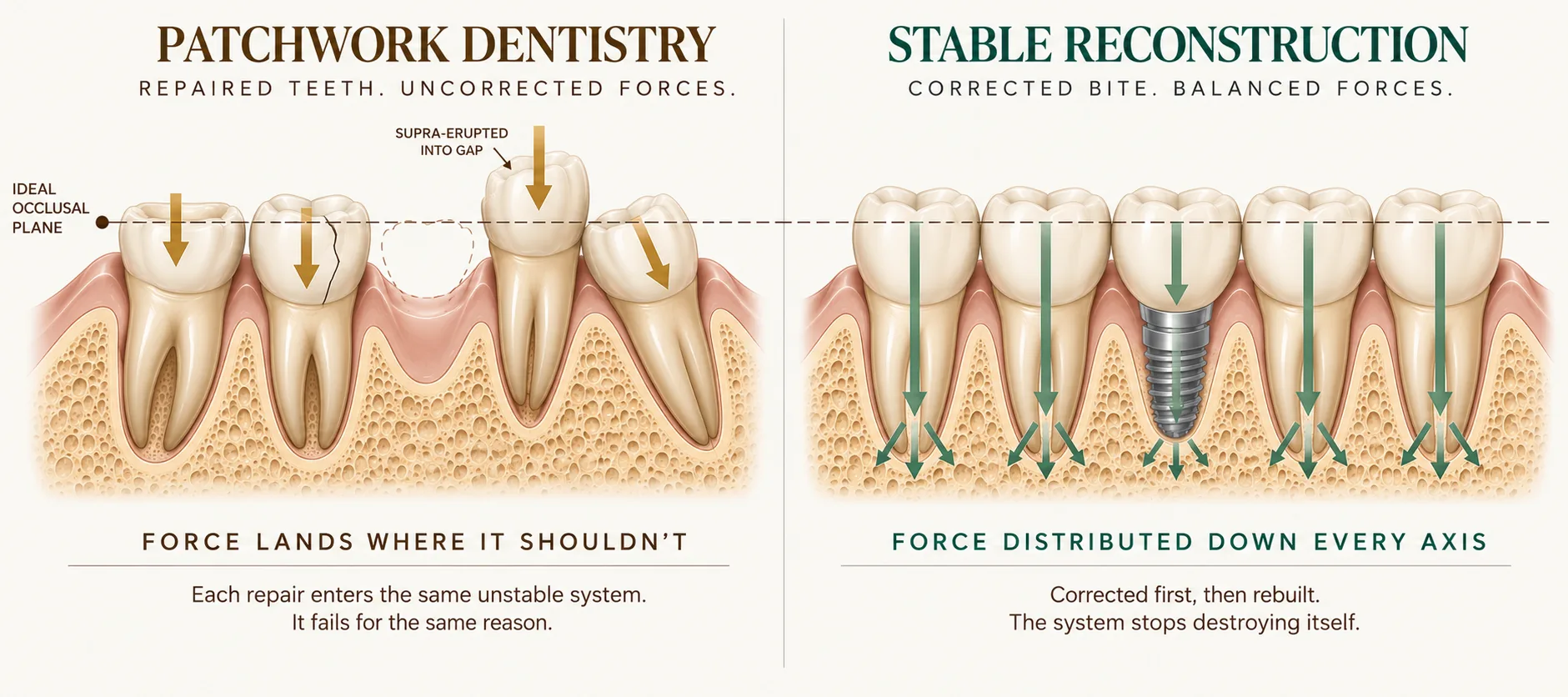
The diagnostic shift.
We don’t begin by asking which tooth needs another crown. We begin by asking why the system keeps breaking down.
The failure cycle, patchwork vs systemic & the four presentations — full detail
Why Your Dentistry Keeps Failing.
It is not the materials. It is not the technique. It is the force system — and it has never been corrected.
Every chewing cycle applies force across the entire bite system. When the jaw joint is not in its correct resting position, those forces are misdirected — landing on wrong teeth, wrong roots, and wrong contacts with every single bite.
Each crown, bridge, and filling is placed into a bite that was never corrected. The new restoration immediately begins absorbing the same off-axis forces that destroyed its predecessor. Without correcting the underlying forces, the same failure pattern tends to repeat.
Another fracture. Another emergency appointment. Another repair placed into the same unstable system. The dentistry is not the problem. The diagnosis was. Patchwork dentistry treats each symptom individually while the force system that caused it continues unchanged.
Tooth breaks → crown placed → crown fractures → new crown placed → repeat
Bite instability is never assessed — only its consequences are treated
Each restoration is designed in isolation, not as part of a coordinated bite architecture
Increasing cost, increasing complexity, decreasing confidence in dental treatment
Diagnose the force system first — find where the jaw joint actually belongs
Design every restoration within a coordinated bite architecture that distributes force correctly
Test the entire result before anything is permanently bonded — approve it under function
End the breakdown cycle — restorations that work because the system that holds them is stable
The diagnostic shift: Full mouth reconstruction does not begin with the question "which teeth need crowns?" It begins with "why do your teeth keep breaking?" That question shapes everything that follows here.
Total Dental Rehabilitation · Venice, FL
When Individual Repairs Are Not Enough.
Full mouth reconstruction is indicated when the pattern of failure is recurring — not when a single tooth breaks, but when teeth and restorations keep breaking despite repair. The four clinical presentations below are the most common reasons patients arrive at this diagnosis.
The patients who benefit most from dental rehabilitation are not necessarily those with the most decay. They are those whose bite has been destroying their teeth faster than individual repairs can keep up. The diagnosis is not which teeth are broken — it is why they keep breaking. Comprehensive dental restoration begins with that question. Dental implants in Venice, FL are often a core component of the reconstruction plan when failing or missing teeth are part of the presentation.
Begin Your AssessmentThe diagnosis points to the cause. The three pillars address it.
The Reconstruction Blueprint · The Clinical Foundation — A plan for a stronger, healthier smile. Four key elements. One complete system.
Full mouth reconstruction — occlusal reconstruction of the whole bite — is built on a functional foundation. Every case is individually planned, but the same four elements guide our approach: joint position first, vertical dimension second, occlusal design third, materials last.
-
Joint position
A stable starting point.
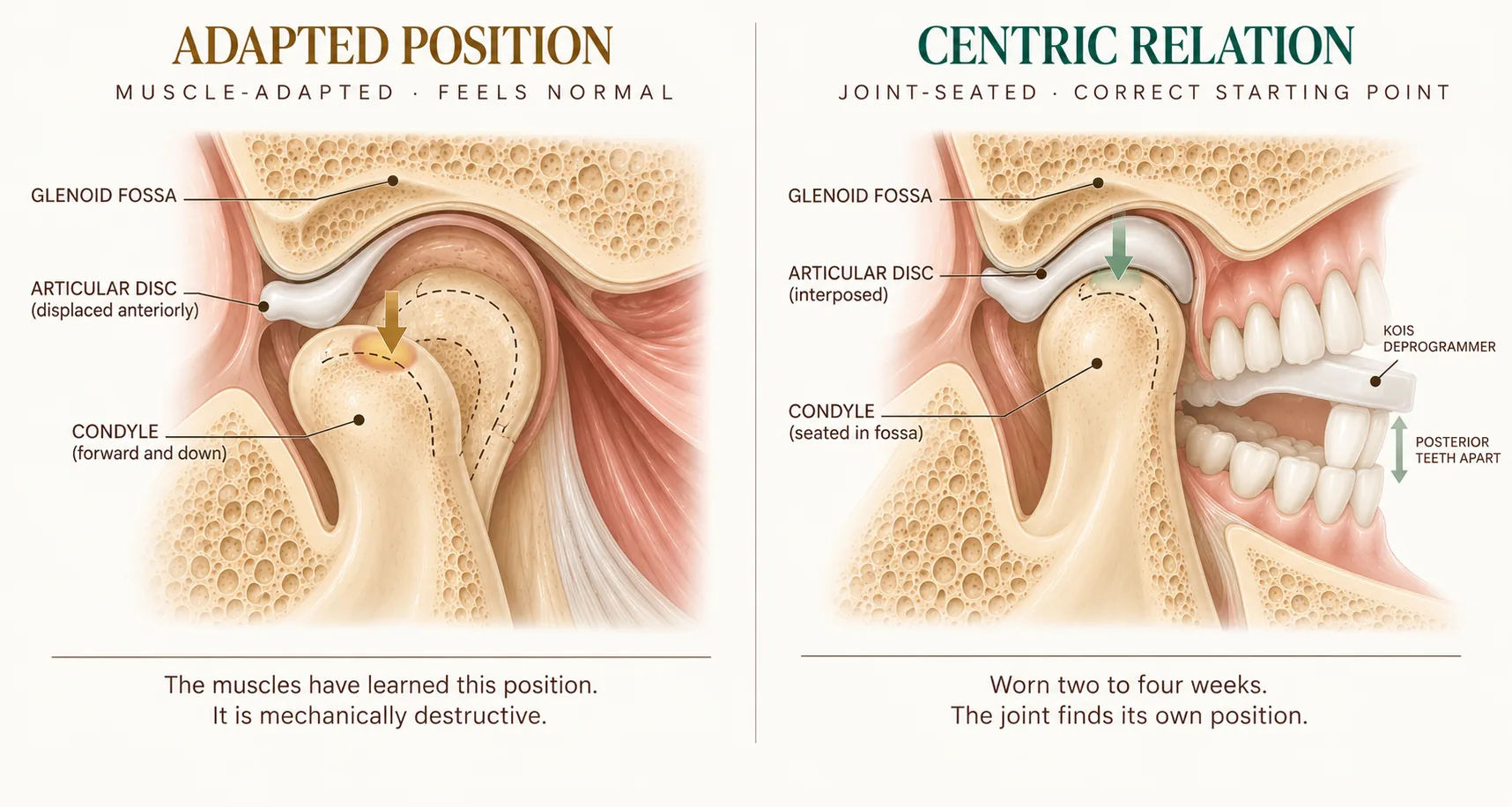
We use Kois principles, including the Kois Deprogrammer, to establish a repeatable, comfortable joint position — centric relation — before designing your reconstruction. The deprogrammer is worn for two to four weeks so the TMJ can settle before any tooth is prepared.
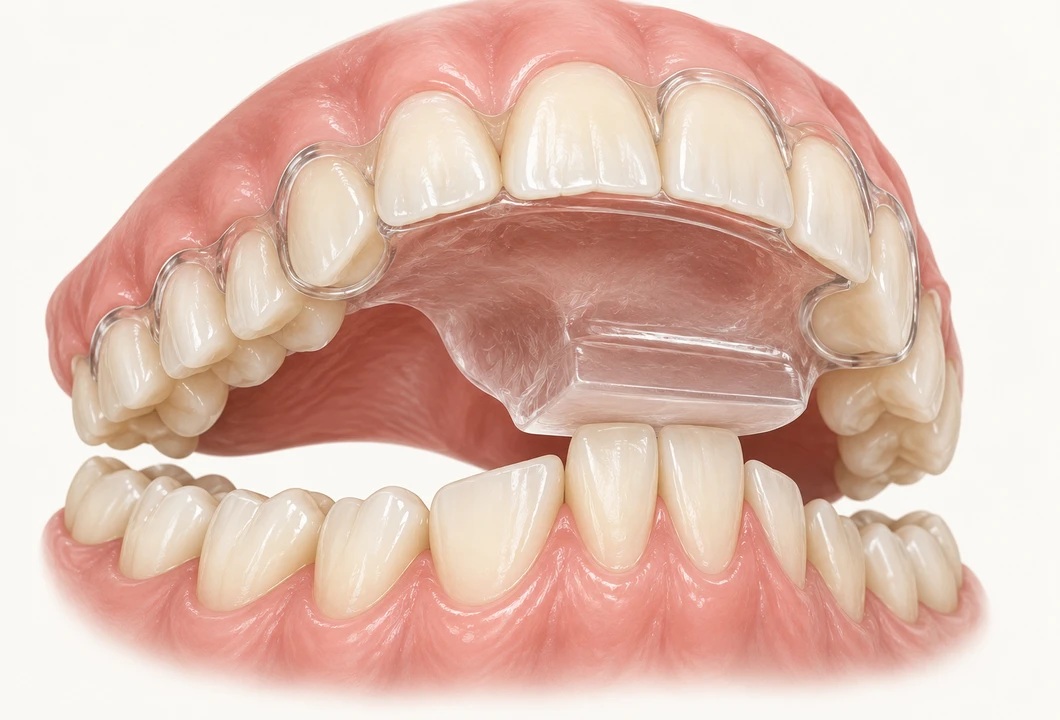
Kois deprogrammer · anterior platform only - Relaxes jaw muscles
- Finds a consistent joint position
- Provides a stable foundation for planning
-
Vertical dimension
Restore what was lost.
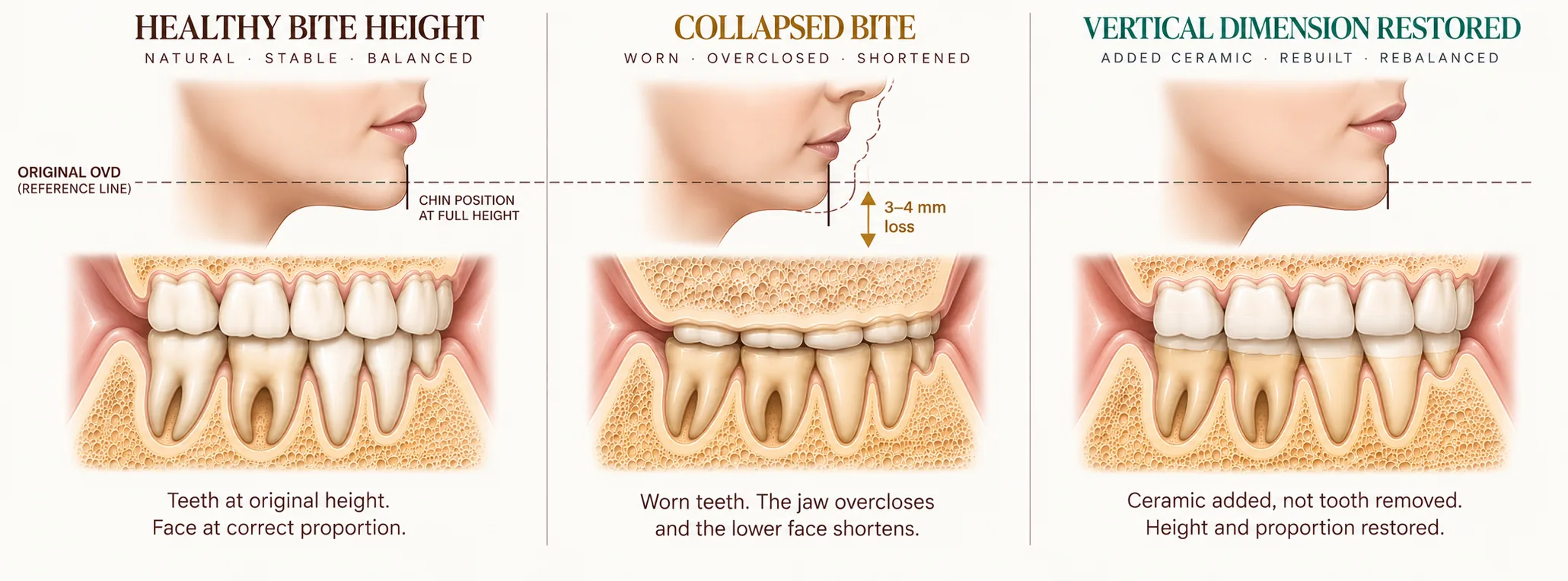
When teeth wear down, occlusal vertical dimension (OVD) is lost and the lower face can collapse. We restore that lost height to rebuild function, facial support and aesthetics, measured against your own facial architecture with a RayFace scan where appropriate.
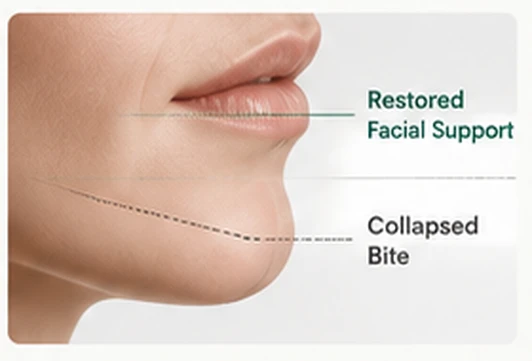
Restored facial support vs collapsed bite - Rebuilds facial support
- Improves function and comfort
- Helps prevent further wear
-
Occlusal design
Guide the forces. Protect the result.
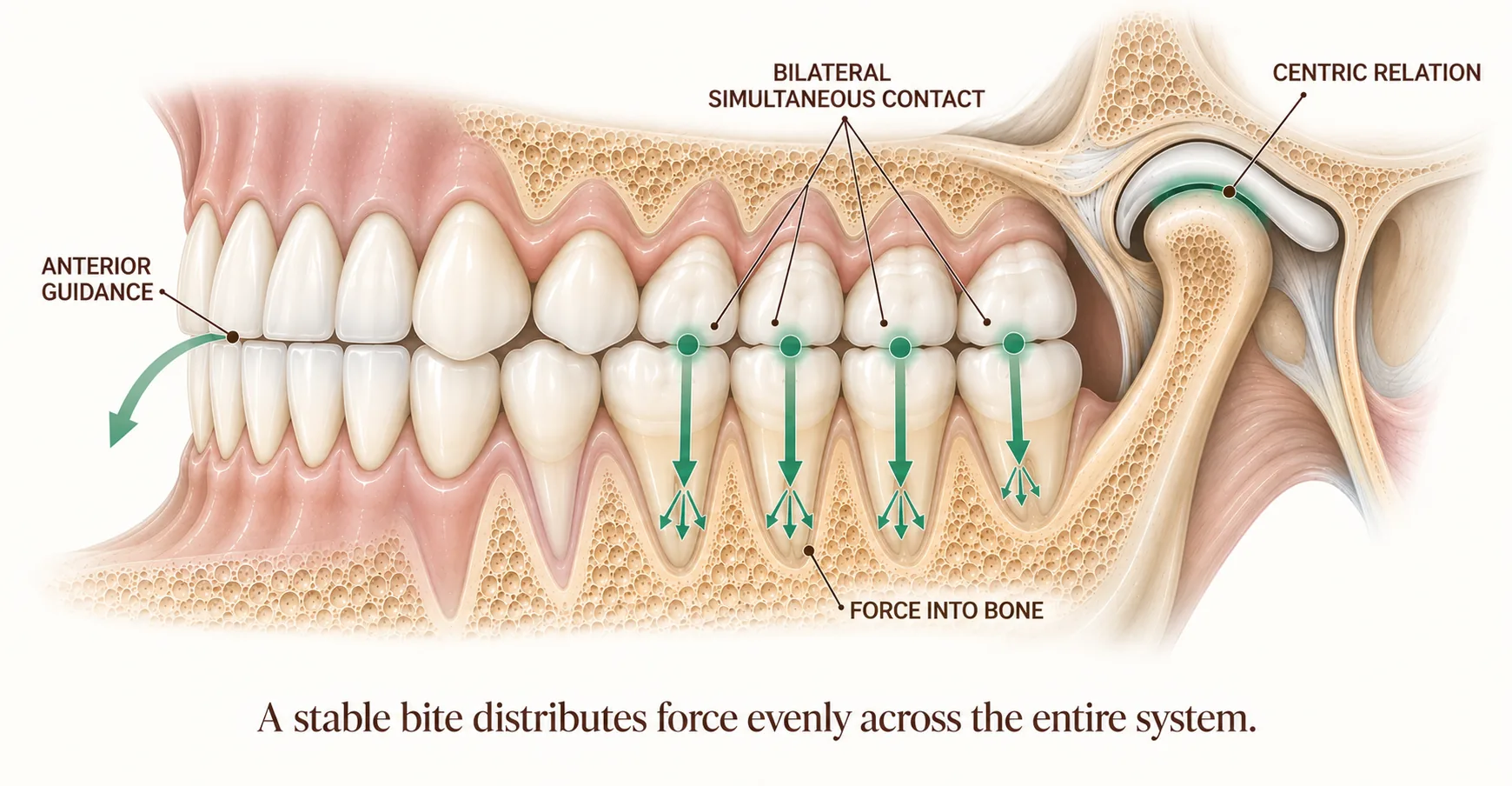
Occlusal reconstruction means designing your bite within a functional envelope, mapping every movement rather than a single closed position. Anterior guidance separates the back teeth during lateral movement, and bilateral simultaneous contact distributes load evenly, protecting the joints, teeth and restorations for the long term.
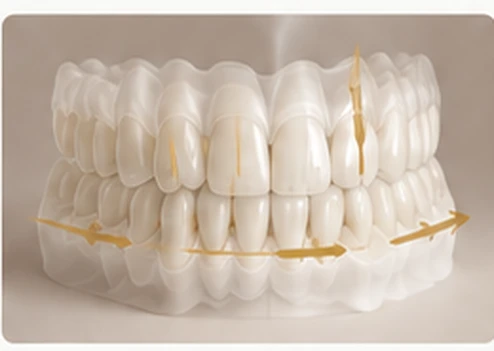
Functional envelope · anterior guidance - Bilateral simultaneous contact
- Anterior guidance
- Designed for long-term stability
-
Material zones
The right material in the right place.
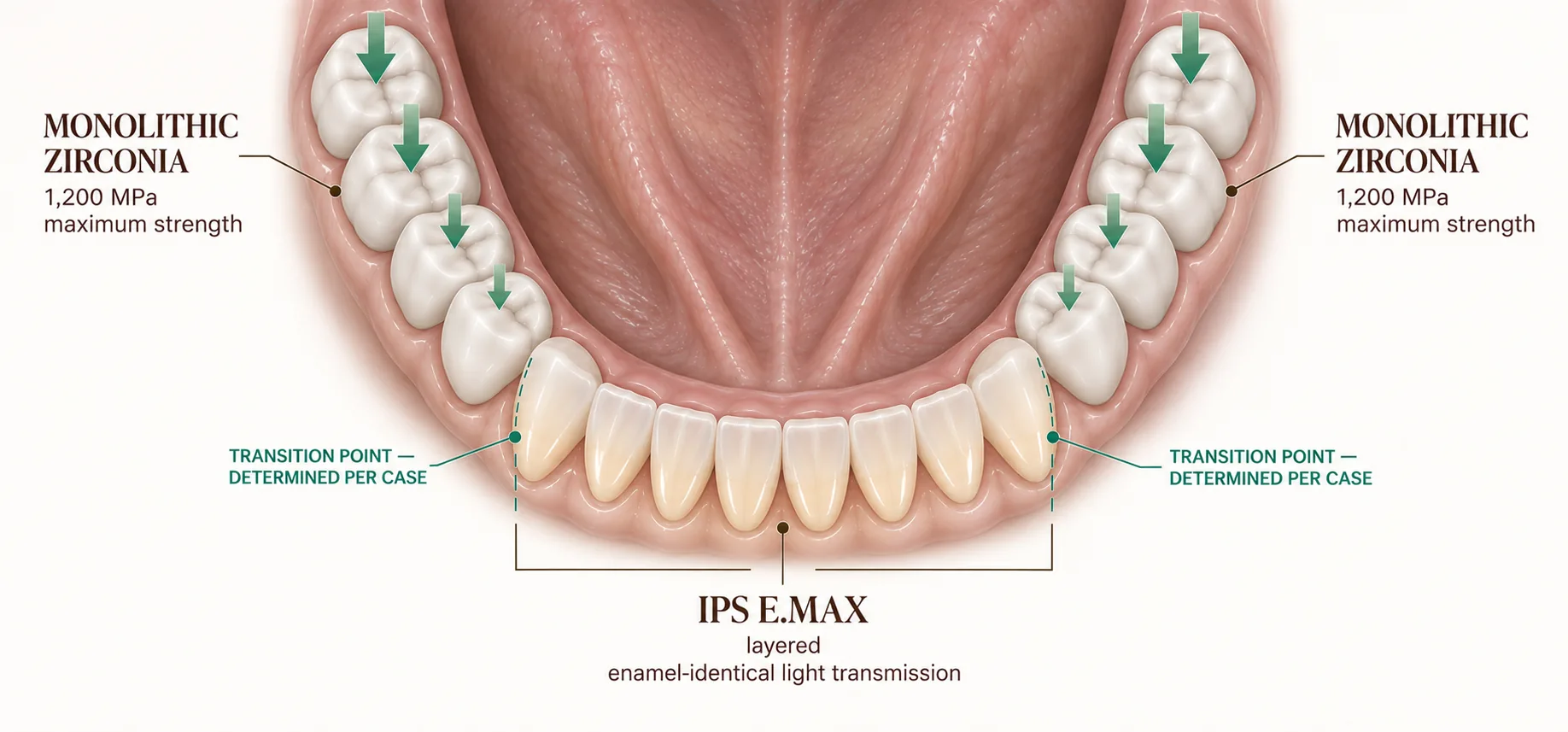
We use different materials for different demands — monolithic zirconia in the posterior for maximum strength (about 1,200 MPa) and layered IPS E.max in the anterior, whose refractive index of about 1.52 sits close to natural dentin. The same logic governs dental bridges as part of reconstruction.
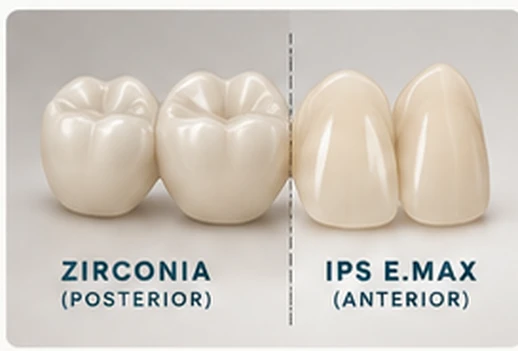
Zirconia posterior · IPS E.max anterior - Strength where it’s needed
- Beauty where it shows
- Materials selected for your case
Centric relation, OVD & material synergy — full clinical detail
Kois Occlusal Philosophy
The Bite Is an Orthopedic System.
“Many bite reconstruction failures are not material failures. They are occlusal failures — restorations built without understanding the forces acting on them. At Smile Spot, every occlusal decision is governed by the Kois functional framework: joint first, muscle second, tooth third. In that order, always.”
The Kois occlusal philosophy underpins everything at Smile Spot — from a single dental crown to a complete Kois occlusal philosophy deep-dive. The foundations below explain why.
The bite is a range of movements — not a single closed position. A reconstruction that only verifies closure produces restorations that interfere laterally, applying off-axis forces to roots and joints with every chewing cycle. The Kois functional envelope maps every movement direction before any tooth position is finalised.
In a correctly designed bite, the anterior teeth guide lateral jaw movement — separating the posterior teeth from contact and protecting their roots from off-axis forces. Without anterior guidance, every lateral chewing movement applies torque across all posterior roots simultaneously. Over time the ceramics are more likely to fracture under function, regardless of material strength.
Bite contact must be simultaneous on both sides and evenly distributed across the posterior teeth. A premature contact on one side creates a fulcrum — concentrating force on that tooth, distracting the TMJ opposite. The result: asymmetric wear, joint pain, fracture.
Weeks of prototype wear reveal what digital models cannot: phonetic interferences, lateral contact errors, and muscle adaptation to the new vertical dimension. The detailed explanation of the prototype phase is covered above in Phase III.
Milled from a single solid ceramic block at 1,200 MPa — among the highest flexural strengths of any crown material in clinical use. The posterior teeth absorb occlusal loading forces that fracture less robust materials over time. Monolithic Zirconia absorbs these without fracture, maintains occlusal anatomy without wear, and provides a dense, non-absorbent, 100% metal-free surface.
Lithium disilicate glass-ceramic with a refractive index of 1.52 — close to natural dentin (about 1.54). E.max transmits and diffuses light from within the material rather than reflecting it from the surface. A zirconia anterior tooth reads as a material in natural light. An E.max anterior tooth reads as a tooth. Anterior teeth are hand-layered to the specific shade prescription that matches surrounding tissue and the patient’s individual colour characteristics. Porcelain veneers and cosmetic restoration at Smile Spot follow the same standard.
The Clinical Foundation
Three Pillars of Reconstruction.
Reconstruction at Smile Spot follows a specific clinical sequence: joint position first, vertical dimension second, restorative materials third. Each pillar depends on the one before it. None can be skipped.
Centric Relation — Finding Home Base
Many patients seeking full mouth reconstruction have been biting in an adapted position for years. The muscles have adapted to that position — it feels normal but it is mechanically destructive. Building new teeth to match this adapted position rebuilds on the same broken foundation. Centric relation is where the TMJ is most relaxed and correctly seated. It is the starting point for all reconstruction. The Kois Deprogrammer — worn for two to four weeks before any preparation begins — releases the muscle memory of the old bite and allows the joint to find its correct resting position.
Opening the Bite — Rebuilding the Face
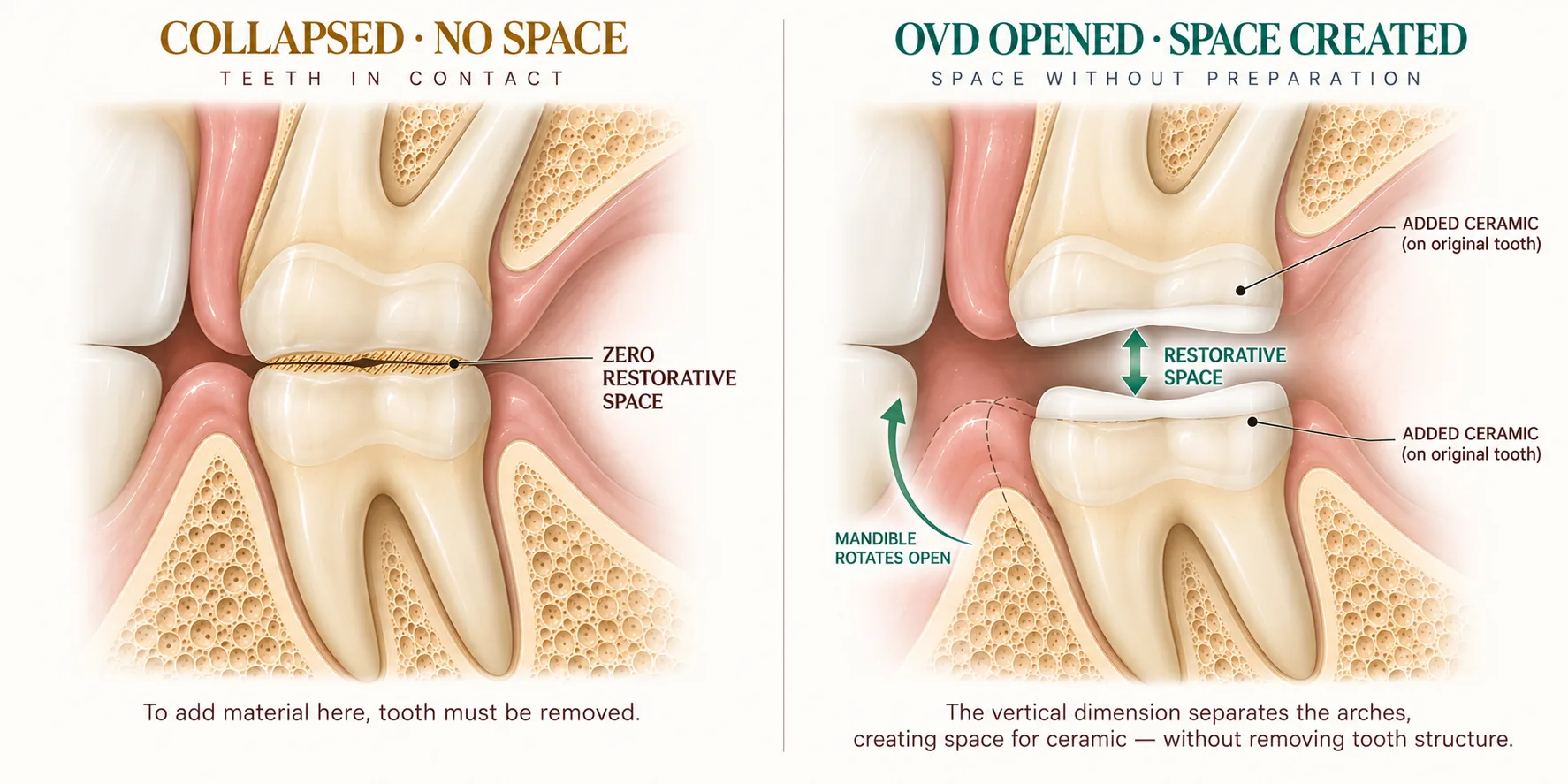
Occlusal vertical dimension (OVD) is the height of the lower face when the teeth are in contact. When teeth wear down — through bruxism, acid erosion, or abrasion — the OVD decreases, the jaw overclosures, and the lower third of the face shortens. Reconstruction reopens the OVD by adding ceramic where teeth have been lost rather than grinding more away. The patient experiences this as the face opening back up — lips regaining projection, profile returning to proportions that photographs from twenty years earlier confirm were correct. The RayFace facial scan measures this against the patient's actual facial architecture.
Mixed Materials — Right Tool, Right Zone
Each region of the mouth has different demands. The posterior teeth absorb the majority of bite force — they require maximum strength. The anterior teeth are the aesthetic zone — they require optical properties that match natural enamel. Using the same material across both zones compromises each. Monolithic Zirconia in the posterior for 1,200 MPa force resistance. Layered IPS E.max in the anterior for enamel-identical light transmission. The transition point is determined per case by Kois occlusal analysis — never by default. This same logic governs dental bridges as part of reconstruction.
Once the foundation is stable, the reconstruction itself can begin.
Before final ceramics · The Boutique Process — Wear the new bite. Then make it permanent.
Before the definitive restorations are completed, a full-arch prototype allows the planned reconstruction to be evaluated under real function — for weeks, in daily life, not for minutes in a chair.
Bite
Does it feel stable during function?
Speech
Are phonetics comfortable and natural?
Appearance
Do tooth position and facial proportions feel right?
Muscle response
How does the new vertical dimension feel over time?
Adjust the prototype. Not the final ceramic.

The four phases & the prototype test drive — full detail
The Boutique Process
Four Phases. One Coordinated Architecture.
Full mouth reconstruction is a single master plan executed in sequence. Every phase informs the next. No phase is skipped. Every decision made digitally and reversibly before it is made clinically and permanently.
Phase III · The Differentiator
You Approve the New Bite Before It Is Permanent.
Few treatments of this scale are tested before they are made permanent. This one is. A complete full-arch prototype is worn, tested, and approved under real conditions before a gram of final ceramic is produced.
Begin Your Consultation
Occlusal contacts verified under real function — eating, speaking, clenching — before any permanent commitment.
Speech interferences exposed weeks before final ceramics are produced.
Evaluated in natural light, in photographs, in daily life — not under clinical lighting.
Weeks of wear allows muscle adaptation to the new vertical dimension. Changes to a digital file. Not to irreversible ceramic.
"The prototype is not a courtesy. It is the mechanism that makes the final delivery predictable."
For those who want to understand the engineering behind the result.
Cost & Investment · Full Mouth Reconstruction, Venice FL — An investment in long-term health.
Full mouth reconstruction is a customized treatment plan, and the investment varies with your individual needs. After a comprehensive evaluation we provide a detailed plan and written estimate tailored to your goals.
$25,000 – $35,000+
Extensive crown rehabilitation on natural teeth
$40,000 – $60,000+
Reconstruction involving multiple dental implants
Complex implant and bone grafting cases are quoted after custom treatment planning.
What influences the cost?
Several factors affect the overall investment. The most common cost drivers:
Number of teeth
The more teeth that need to be restored, the greater the investment.
Material selection
Options include monolithic zirconia and IPS E.max, each allocated by zone.
Additional procedures
Some cases require tooth extraction, dental implants or bone grafting.
Level of complexity
Each plan is customized around your bite, joint health and aesthetic goals.
- InsuranceMost PPO plans cover part of the restorative components. Staging treatment across plan years can help maximise benefits, and we handle the paperwork.
- FinancingCareCredit and Cherry are available, with HSA and FSA accepted.
- Your next stepSchedule a consultation to discuss your goals and receive a detailed treatment plan and written estimate.
Full Mouth Reconstruction · Venice, FLFunction. Aesthetics. A healthier future.
Outcomes · What You Are Actually Buying — The goal is not more dentistry. It’s a more stable system.
A well-planned full mouth reconstruction changes the conditions that led to ongoing problems, so you can move forward with greater stability, function and confidence.
Fewer crises
Move away from recurring fractures, repairs and emergency appointments.
Predictable maintenance
Routine hygiene, examinations and monitoring replace constant reactive treatment.
Preserve what remains
Protect remaining tooth structure, supporting tissues and the reconstruction through appropriate force management.
Functional comfort
A bite designed so eating, speaking and everyday function feel more comfortable and predictable.
What changes after reconstruction — full detail
What You Are Actually Buying
The End of The Breakdown Cycle.
Full mouth reconstruction is not a cosmetic outcome. It is a structural one. The result is not a beautiful smile — though that follows. The result is a mouth that functions correctly, loads force correctly, and stops breaking.
Patients who complete reconstruction typically describe the same experience: they had become so accustomed to managing dental problems that functioning without them feels like a fundamental change in quality of life. Not cosmetically. Structurally.
Restorations designed within a stable force system are far less likely to fracture under normal function, and the pattern of recurring emergency appointments usually settles.
Twice-yearly hygiene visits. Routine radiographs. No crisis management. Dental care returns to what it was always supposed to be: preventive, not reactive.
Bone, gum tissue, and tooth structure preserved under a correctly loaded bite. The cascade of secondary losses — bone resorption, adjacent tooth damage, joint strain — is slowed.
Eating without avoidance. Speaking without self-consciousness. Sleeping without bruxism damage continuing to accelerate. The jaw operates in a position that muscles no longer fight against.
The cost framework that matters: The question is not what full mouth reconstruction costs. The question is what another ten years of patchwork dentistry costs — in money, in time, in the progressive deterioration of a system that was never corrected.
Common Questions — Full Mouth Reconstruction Answered.
Straightforward answers to the questions we hear most about full mouth reconstruction in Venice, FL — from treatment decisions to cost, time and insurance.
Treatment & decisions
Full mouth reconstruction is indicated for patients with systemic bite damage — not just individual failing teeth. The four primary presentations are: severe bruxism damage causing worn, fractured, and shortened teeth; acid erosion from GERD or dietary acidity affecting multiple teeth simultaneously; multiple failing restorations (crowns, bridges, fillings) from a previously unaddressed occlusal problem; and congenital or developmental conditions affecting multiple teeth. The diagnostic signal is a pattern of recurring restoration failure — teeth and prosthetic restorations that keep breaking because the dental occlusion driving the damage was never corrected.
A smile makeover is primarily a cosmetic procedure — porcelain veneers and cosmetic restoration focused on the appearance of the front teeth. Full mouth reconstruction addresses the entire bite system: joint position, vertical dimension of occlusion, occlusal stability, and prosthetic restorations across every functional zone. It is indicated when the underlying cause of failing teeth is the bite mechanics themselves. A smile makeover on a dysfunctional bite will produce cosmetic results that fail within years. Reconstruction corrects the foundation first — the cosmetic outcome is the result of that foundation, not a surface applied over it.
The Kois Deprogrammer is a small, removable anterior device worn for 2–4 weeks before any reconstruction preparation begins. It contacts only the front teeth, allowing the jaw muscles to fully release their adaptive tension and the TMJ to find its true centric relation position. Building a reconstruction on an adapted muscle position rather than centric relation means building on the same destructive bite pattern that failed the previous restorations. The Kois Deprogrammer eliminates this risk entirely. It is the most important diagnostic step in any bite reconstruction case — and and it is often skipped when a case is planned without a functional framework. Learn more on our dedicated Kois occlusal philosophy page.
The reconstruction process involves local anesthetic for all preparation appointments — the clinical procedures themselves are painless. Post-preparation sensitivity is normal and resolves within days. The prototype phase is fully functional and comfortable — patients eat, speak, and socialise normally while wearing it. If dental implants are part of the reconstruction, surgical placement involves local anesthetic and typically produces mild soreness for 3–5 days managed with standard over-the-counter pain relief. The most commonly reported experience from our full mouth reconstruction patients: they wish they had done it sooner.
Time & investment
Full mouth reconstruction cost is determined by structural complexity, not by the number of crowns placed. The primary variables: whether existing teeth can be restored or require extraction; whether dental implants in Venice, FL are required to replace missing teeth; whether bone grafting is needed before implant placement; the degree of bite collapse and vertical dimension loss; material allocation across the arch; and whether treatment is staged across multiple years or delivered in a single phase. Typical ranges: extensive crown rehabilitation on natural teeth runs $25,000–$35,000+, and reconstruction involving multiple implants runs $40,000–$60,000+. Most PPO plans cover restorative components partially — staged treatment can be coordinated across plan years to maximise benefits. CareCredit, Cherry, HSA and FSA are accepted, and a detailed investment breakdown is provided at your consultation.
Full mouth reconstruction at Smile Spot typically takes 6–18 months from the first Kois Deprogrammer fitting to final ceramic delivery. The timeline depends on whether dental implants in Venice, FL are part of the plan (implant osseointegration requires 3–6 months), how many phases the reconstruction is divided into, and the complexity of the occlusal correction required. Phase I (deprogramming) takes 2–4 weeks. Phase II (digital blueprint and treatment planning appointment) follows immediately. Phase III (prototype) typically runs 3–6 weeks. Phase IV (final delivery) is the concluding clinical appointment.
Most PPO dental insurance plans cover the restorative components of full mouth reconstruction as major restorative procedures — typically at 50% after deductible. However, most plans have annual maximums of $1,500–$2,500, which is a fraction of the total investment. The strategy at Smile Spot: phase the reconstruction intelligently across two to three insurance years to maximise benefit utilisation. Our concierge team performs a comprehensive insurance for dental reconstruction analysis before your consultation — you receive exact benefit projections, not estimates. CareCredit and Cherry financing provide flexible dental financing for large cases with HSA and FSA also accepted.
Full Mouth Reconstruction · Venice, FL
Stop repairing the symptoms. Rebuild the system.
Schedule a consultation to discuss your goals and receive a personalized treatment plan.
What happens at your reconstruction consultation
Schedule your comprehensive reconstruction consultation at Smile Spot Dentistry — Venice Island’s boutique restorative dental institute at 273 S Tamiami Trail. Dr. Sellappan will review your dental records and radiographs, assess your bite mechanics, and present a complete treatment plan with investment breakdown — before you commit to anything. Full mouth reconstruction cost is verified at consultation. CareCredit and Cherry financing available. Bite therapy and occlusal correction are also offered as standalone services for patients earlier in the restorative journey.
A stronger, healthier smile
for what’s next.